

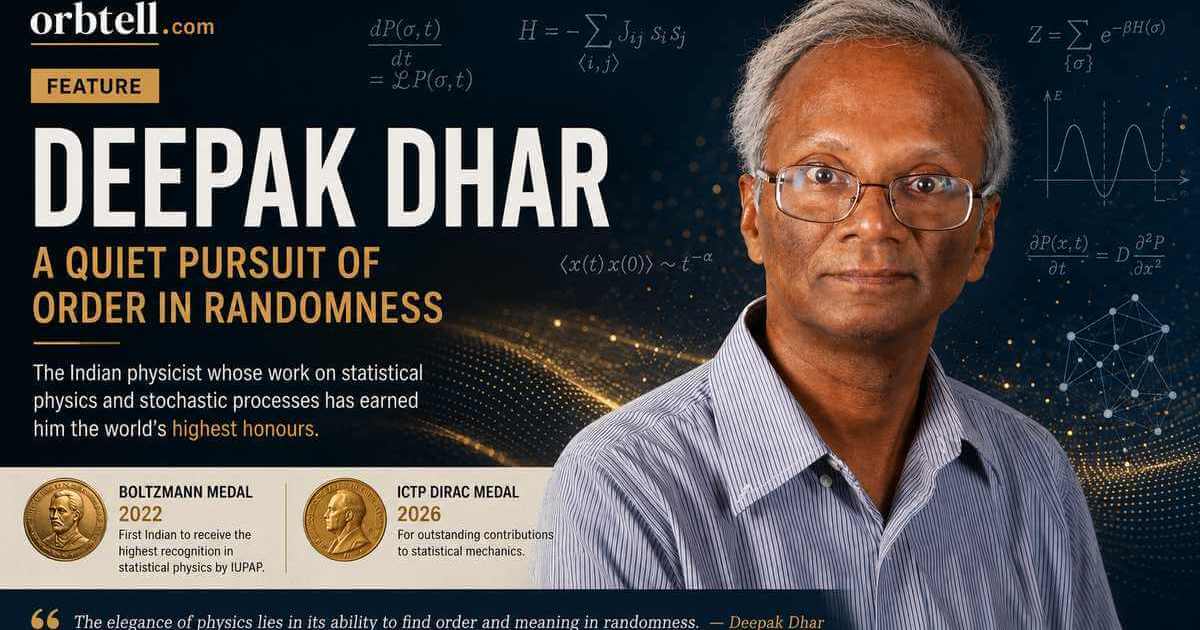
The world of Indian theoretical physics has received another major recognition! At the age of 75, Padma Bhushan awardee Deepak Dhar has added yet another honour to his achievements: the Dirac Medal. The Dirac Medal is one of the highest honours in physics. Every year, the International Centre for Theoretical Physics (ICTP) presents this prestigious award in honour of the renowned physicist Paul Dirac for outstanding contributions to theoretical physics.
The award was once received by the world-renowned scientist Stephen Hawking. In 2026, four scientists will be honoured with this award, and Deepak Dhar is one of them. The other three are physicists Bernard Derrida, Marc Mézard, and Haim Sompolinsky. Dhar was selected for his pioneering research in statistical mechanics.
Deepak Dhar, Early Life
The theoretical physicist Deepak Dhar was born in October 1951 in Pratapgarh, Uttar Pradesh. After completing his school education, he obtained a Bachelor’s degree in Science from Allahabad University in 1970 and then completed his postgraduate studies at IIT Kanpur. He subsequently went abroad for higher education. In 1978, he earned his PhD from Caltech in California. Unlike many other scientists who stayed abroad, he returned to India.
Deepak Dhar and his notable work
In the same year, 1978, he began his professional career as a researcher at the Tata Institute of Fundamental Research (TIFR). This marked the beginning of his career. After conducting research at TIFR for two years, he joined the institute as a full-time researcher. In this way, he held various positions at the Tata Institute of Fundamental Research for 36 years. However, in between, in 1984, he joined the University of Paris as a visiting faculty member for one year.
Even after his formal retirement, he continued to remain associated with TIFR as a distinguished faculty member. Alongside this, he also served as a distinguished visiting professor at IISER Pune. Thus, his life continued to revolve around his work and research.
Research seemed to be the driving force of his life. Through his research in statistical physics and stochastic, or random, processes, Professor Dhar studied the statistical mechanics and dynamics of random lattices. His research has provided a deeper understanding of these branches of physics. Therefore, it is quite difficult to describe the full scope of his research in just a few words.
The recognition of his work was not limited to the Dirac Medal. His list of honours includes numerous prestigious awards, such as the Shanti Swarup Bhatnagar Prize in 1991. In 2022, he became the first Indian to receive the Boltzmann Medal for outstanding contributions to statistical physics. The following year, he received the Padma Bhushan from the Government of India. He has also received the J. Robert Schrieffer Prize in 1993, the Satyendra Nath Bose Medal in 2001, and many other prestigious awards. Speaking about receiving awards, he has said that researchers generally do not work merely for awards or recognition.
There is no doubt that his contribution to theoretical physics is remarkable. His famous words, “The reason we learn something is that it makes me a better person, not because it gives me better grades!” may serve as a key to moving forward for the next generation.
