

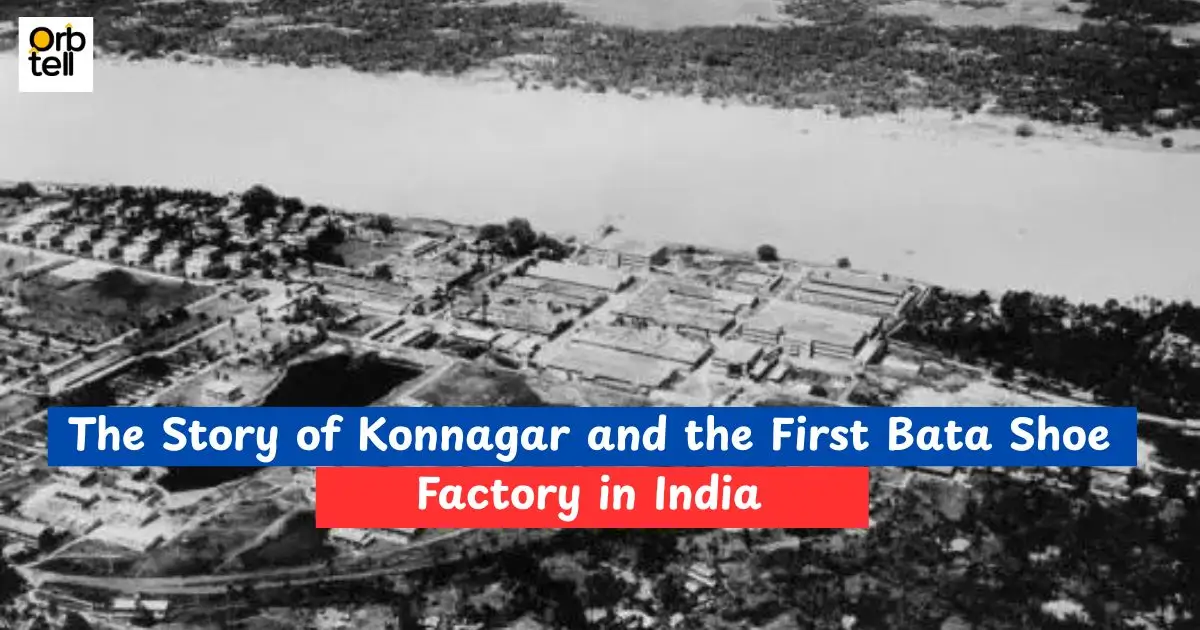
Morning in Calcutta on a Winter Day, 1932
It was a winter morning in 1932. A middle-aged Czech gentleman was sitting in a shoe store on Chitpur Road. Crowds of people were walking along the busy street in front of him. Among them, a particular sight caught the gentleman’s eye.
An old rickshaw puller, dressed in a short dhoti and a tattered shirt, was resting wearily on the street. Blood was oozing from the wounds on his dusty, grimy feet. Countless footprints of his dusty, bloody feet were imprinted on Chitpur Road. After resting for a while, the man took his hand-pulled rickshaw and moved forward again.
This small incident left a lasting impression on the mind of the Czech gentleman.

In fact, in colonial India, very few people could afford to buy shoes. At most, ten million pairs were imported from Japan for India’s 330 million inhabitants. At that time, buying shoes was a dream for most people. The vast majority of People could not able to afford their daily needs. If a footwear option exists in the market its meant for the upper class; walking barefoot was the only option for the general public.
A few days after this incident, that middle-aged Czech gentleman was seen standing for hours on end in a corner of the Howrah footbridge. His gaze was fixed on the feet of the people. He would pull a notebook from his pocket and sketch. On the first page of the notebook, in large letters, was written the gentleman’s name:
Tomáš Baťa (Thomas Bata).
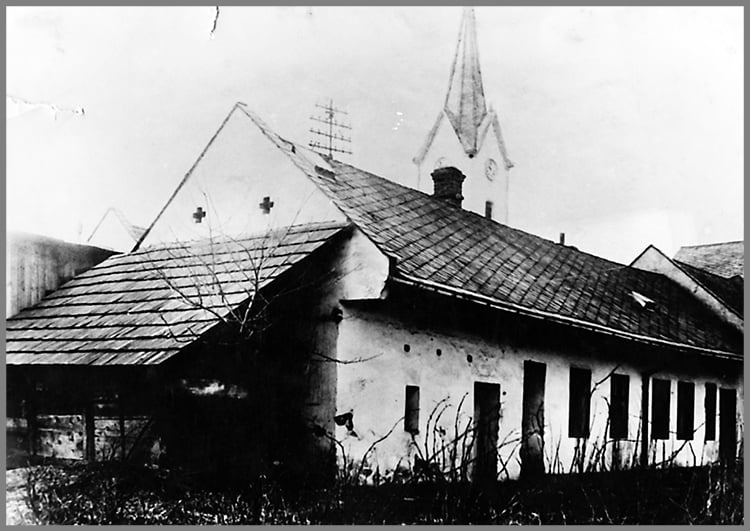
Tomáš Baťa was born in Zlín, in a 7th-generation local shoemaker family. With Tomáš Baťa‘s direct ancestor mentioned back in 1967 as a shoemaker in Zlín.
Table of Contents
From that day on, the planning began to build Bata’s first factory on the subcontinent.

The Search for a Factory Site
Within a few days, Mr Tomáš learned that there was an abandoned oil mill — the Hati Kul Oil Mill — in the village of Konnagar on the banks of the Ganges. Although the Anderson Wright Company of Calcutta had operated that oil mill, it had shut down three years prior, unable to withstand the impact of the Great Depression of 1929.
Even before that, the site of the oil mill had been home to a Danish dock and shipyard. Those, however, were things of the past century.
Mr Thomas leased this factory in Konnagar for five years.
Overnight, everything — including the warehouses and offices in Kolkata — was moved to the heart of Konnagar. Along with it came a team of fourteen young Czech gentlemen. Accommodation was arranged in the factory’s southern bungalow.
It is said that during the East India Company’s era, Mr G. MacNair had a liquor factory on the site of this oil mill. He likely built this riverside bungalow.

Within a few days, all the bushes and undergrowth on the factory grounds were cleared to build a volleyball court. In a fit of overenthusiasm, the workers dug a swimming pool with their own hands. A “Bata” signboard was put up on the factory gate. Two large iron plates were installed right in the middle of the factory to ring a bell. An iron jetty was built on the bank of the Ganges.
Why Bata Came to India
Previously, Bata shoes had been imported from Czechoslovakia for the last six years since 1925. After import, the price of these shoes was at least five to seven rupees. But for the common people of a country where the daily wage was only a few annas, it was impossible to buy these shoes.
So, what was the solution?
The only solution was to produce Bata shoes in this country, with this country’s leather, by this country’s workers. Only then would the price of shoes fall, import duties be avoided, and the shoes could challenge the cheap Japanese ones.
That was the reason for all the arrangements.
But the road ahead was not smooth.
Early Challenges in Konnagar

The Language Barrier
The Czech gentleman who came to Konnagar couldn’t speak English properly, let alone Bengali. As a result, they faced obstacles at every turn — from hiring new staff and arranging food and provisions to shopping and building a sales network.
The Slipper Problem
The second problem was rather peculiar.
In those days, wearing flip-flops wasn’t common in this country; people were not familiar with the new design. So, keeping in mind the hot and humid climate of India, Bata Company began importing white flip-flops.
But they didn’t sell at all because:
- White gets dirty very easily.
- White is a symbol of mourning for many people in this country.
Thus, Bata’s journey began with a significant financial loss.
Understanding the Indian Market
But Bata’s management learned from the mistake.
Starting in 1932, they opened a training centre for salesmen in Konnagar and tasked some young Czech gentlemen with researching everything from the country’s leather industry to consumer psychology.
Gradually, the Konnagar Bata Club was established. Along with distributing free pairs of Bata shoes to many local people, they were asked to wear them and walk together on the busy streets of Kolkata. As a result, the general public gradually learned to recognise Bata shoes.
In just one year, Bata expanded its retail chain to 86 cities across the country. A retail outlet was also established in Konnagar.
But one significant task remained:
Bata had not yet started producing leather shoes on Indian soil.
The Death of Thomas Bata
On July 12, 1932, Mr Thomas Bata died in a tragic plane crash.
The suddenness of the event brought work to a standstill for a few days. But after Bata Jr. — Thomas J. Bata — took over, he followed in his father’s footsteps and carried the work forward with renewed vigour.
It was decided that a self-sufficient leather workshop would be established at the Konnagar factory, capable of producing up to forty thousand pairs of leather shoes per week.
The Arrival of the Machinery
In December 1932, a ship named Morava set sail for Calcutta from the port of Zlín, carrying all the machinery and twenty engineers.

But the most surprising thing was that to carry out this entire project, Bata management did not provide any capital to the Bata men in Konnagar. On the contrary, five hundred thousand pairs of shoes were sent, and it was stated that the business in India was to be started with the profit from the sale of these shoes.
The ship arrived in February 1933.
After unloading all the heavy machinery at the Port of Kolkata, everything was transported by large boats up the Ganges to Konnagar.
The Shrirampur Bang Laxmi Cotton Mill was contracted to supply the necessary cloth. And in the factory kitchen itself, the chemists began their experiments to vulcanise the leather.
Immediately, two hundred additional workers were needed.
Clash with the Sardar System
In those days, labourers in the Hooghly industrial area were hired through “sardars.” These sardars were a very powerful group of middlemen who controlled everything from the recruitment of contract labourers to their daily wages.
But Bata, completely ignoring these sardars, began hiring directly.
They started paying their workers at the end of the week instead of daily, and the wages were significantly higher than those at nearby factories. However, the influence of the sardars was so great that, at first, the Bata authorities had to struggle to hire labourers without them.
The First Modern Shoe Made in India
Finally, overcoming all these obstacles, on May 1, 1933, the first modern shoe of India was manufactured in Konnagar.

The moment the news reached Bata’s headquarters by telegram, Bata workers all over the world erupted in great enthusiasm.
Then began the battle to capture the market.
Bata’s Plimsolls
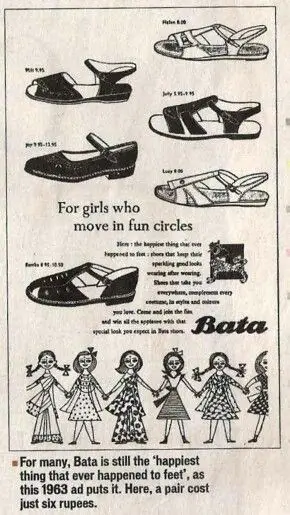
Bata’s plimsolls were inexpensive, durable, and of international quality. As a result, starting in 1934, the “Made in India” Bata shoes began to challenge the monopoly of Japanese shoes in the market.
Previously, shoe prices fluctuated throughout the year depending on imports. But in Bata-established showrooms, everything — from the price of the shoes to the sizes — was standardised.
Resistance Against Bata
As Japanese shoes began losing market share, the first blow came from Indian distributors who had been doing a thriving business importing shoes from Japan.
Using their influence, they began to campaign against Bata throughout Konnagar.
First, rumours spread that Bata had gone bankrupt after Thomas Bata’s death. In the following months, several newspapers published stories alleging that Bata was causing local shoemakers to lose their livelihoods.
Due to this, protests took place against the factory on a small scale.
Additionally, locals reported that protests took place outside the Bata factory over its use of cowhide. The Brahmins of North Konnagar had strong objections to the manufacturing of leather shoes.
Consequently, with the direct encouragement of local landlords, a movement against Bata was initiated.
But even so, the Bata factory continued to thrive.
How Bata Changed Konnagar
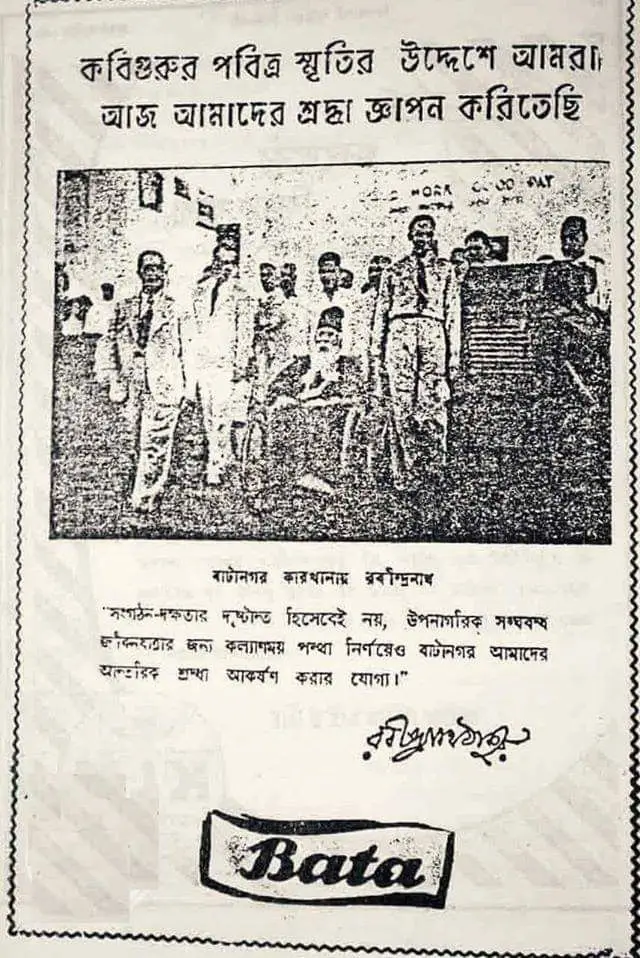
By the end of 1934, about a thousand people worked at the Konnagar factory, of whom about 300 were residents of Konnagar.
The influx of new people also transformed Konnagar’s economy. The size of the market doubled within a few years, and many families became prosperous within just three years, overcoming poverty.
But as business grew, space became a problem in Konnagar.
There were only six rooms in the riverside bungalow, which was home to twelve gentlemen, including two Czech families. Furthermore, the workshop and warehouse did not have enough space.

The Birth of Batanagar
As a result, in 1934, Bata authorities purchased from the Kolkata Port Trust a vast, waterlogged, jungle-covered tract of land on the opposite bank of the Ganges in the Nungi area.
With the laying of the foundation stone on October 28, 1934, modern Batanagar was born.
In September 1935, a grand conference was held in Konnagar for all Bata employees, where the new factory in Batanagar was announced.
That same year, during the Puja holidays on Saptami and Ashtami, nearly all the machinery, along with two hundred thousand pairs of shoes, was moved to the newly constructed factory in Batanagar.
The following year, in May, Anderson & Wright’s lease with Bata ended. In August 1936, the few Czech gentlemen who worked for Bata and lived in Konnagar also bid farewell to Konnagar for the last time.
The Last Signs of Bata in Konnagar
Of course, the last sign of Bata remained on the Konnagar landscape even a decade ago.
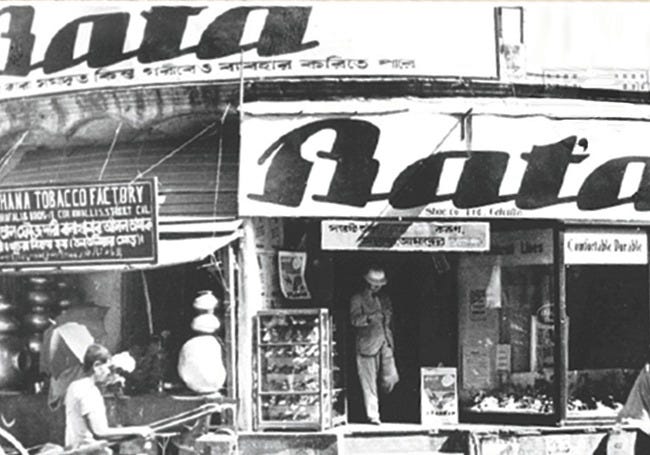
The Bata shoe store, established in 1933 at the intersection of Criper Road and GT Road, closed fifteen years ago after operating for over seventy years.
But people still call that place Bata More.
And what happened to the Japanese shoes that once competed with Bata?
After the 1941 attack on Pearl Harbour, Japanese shipments to India were completely stopped. As a result, Japanese shoes disappeared from the Indian market.
An Important Correction About Bata’s “First” Outlet
Several sources mention that Bata’s first factory and retail shop opened in Konnagar. But this is completely incorrect.
The first Bata shoes in India were brought by a wholesale agency in New Market around 1925–26.
In 1928, a small shop at Chowringhee and Lindsay Street became the country’s first standalone Bata retail outlet.
It was already common for Bata shoes to be sold in retail stores in Kolkata when Thomas Bata arrived.
Hence, the store in Konnagar was not Bata’s first.
However, among all the district towns outside Kolkata, Konnagar was chosen as the first outlet.
Moreover, after Bata’s first shoes were made in Konnagar, they were first available at the Konnagar store. Therefore, before independence, many people would come from far and wide to Konnagar to buy Bata shoes.
Bata Factories In India
After the first factory in Batanagar, West Bengal, Bata India continued to grow and established new factories in major locations to cater to a larger audience.
- Konnagar, West Bengal (1932)
- Bataganj, Bihar (1942)
- Faridabad, Haryana (1951)
- Peenya, Bangalore, Karnataka (1988)
- Hosur, Tamil Nadu (1994)
Tanneries
- Batanagar Tannery (West Bengal)
- Mokamehghat Tannery (Bihar) (1952)
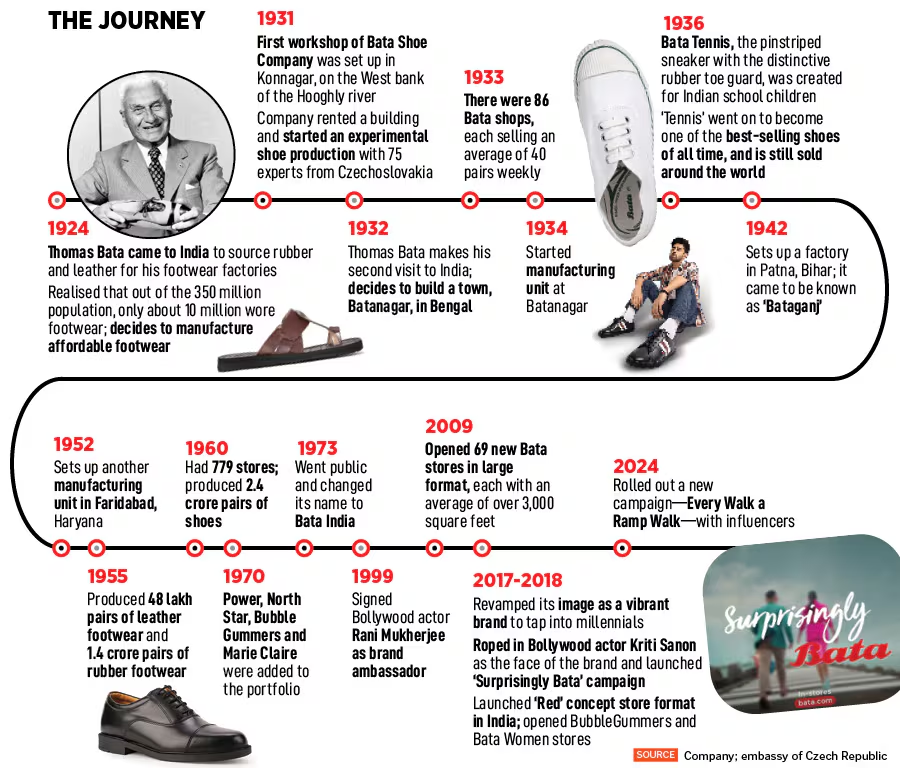
In 2025, Bata India invests 300 Mn Rupees in Batanagar, its first factory in India, to modernise and upgrade its production processes with advanced technology. Bata continued to grow despite huge competition, and Bata is still considered a pioneer of trust and reliability. Currently, they are developing modern designs and unique products to attract younger generations.
Current Condition of the Bata Factory In Konnagar
Here is the top drone shot view of the ruined First Bata factory (Courtesy Arunava Sanyal)
First Czech Investor in India: Bata
