

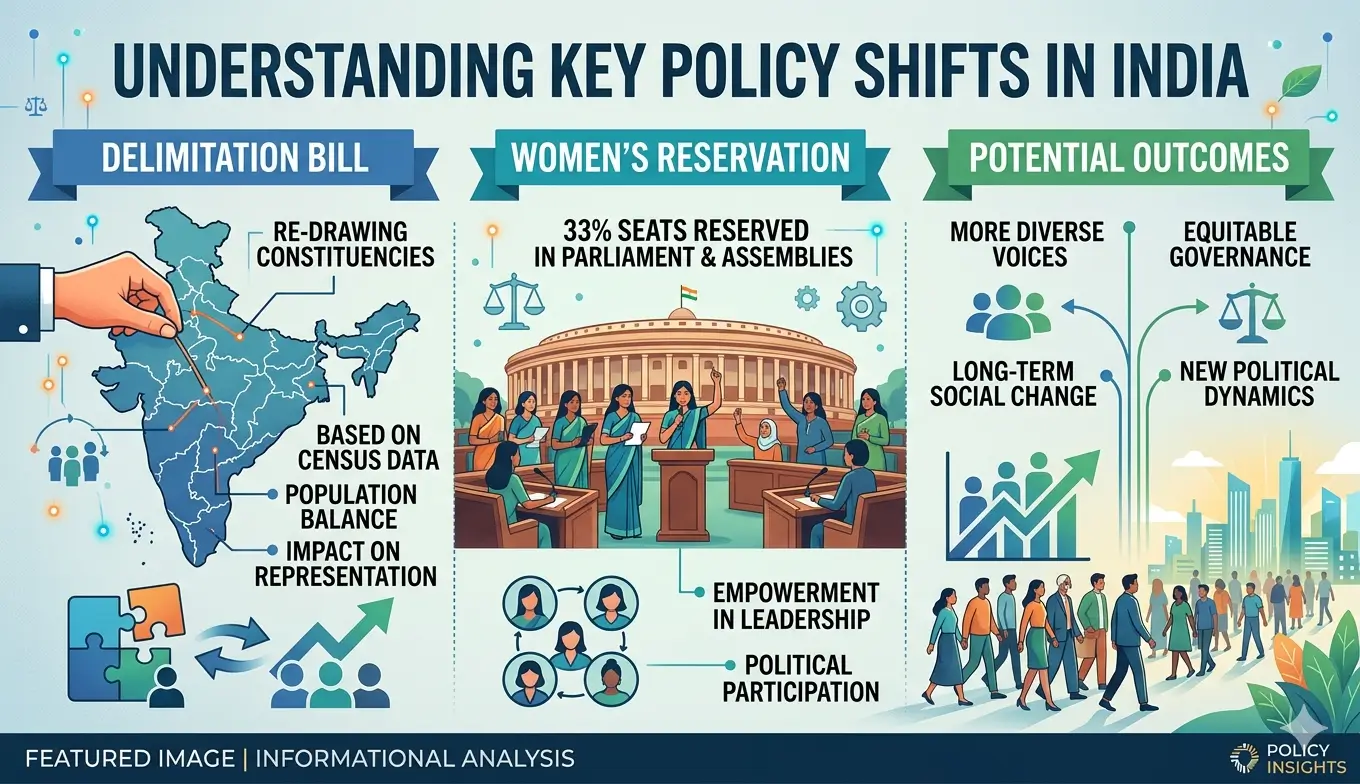
On Thursday, April 16, the Modi government introduced a total of three bills; these are:
- The Constitution (131st Amendment) Bill, 2026
- The Delimitation Bill, 2026
- The Union Territories Laws Amendment Bill, 2026
Among these, the Delimitation Bill, 2026, has garnered the most attention. Since 1976, the number of Lok Sabha seats has effectively remained static; currently, the number of elected members stands at 573.
The Delimitation Bill
The Centre argues that despite the massive population growth. The number of parliamentary seats has not increased to meet this demand. Consequently, based on the 2011 census figures, the responsibility of representing between 2 and 2.7 million people falls upon the shoulders of a single Member of Parliament (MP). Administratively, this presents a significant challenge. With this in mind, the Central Government has formulated a plan to increase the number of Lok Sabha seats to 850.
- Of these, 815 MPs will be elected from the various states.
- The remaining 35 MPs will be elected from the Union Territories.
If the delimitation process is implemented based on the 2011 population figures, the breakdown would be as follows:
| Region | % Increase in Seats | As Share of 543 Seats | As Share of 850 Seats |
|---|---|---|---|
| East | 48.7% | 14.4% | 13.7% |
| Hindi Heartland | 76.8% | 38.1% | 43.2% |
| North East | 33.3% | 4.4% | 3.8% |
| North Non-Hindi | 58.3% | 4.4% | 4.5% |
| South | 33.3% | 24.3% | 20.7% |
| West | 56.4% | 14.3% | 14.4% |
However, the core of the controversy lies elsewhere. If the seat realignment is based on the 2011 census, populous states will gain more seats, while southern states, which have successfully implemented population control measures, will end up with fewer seats.
In other words, the equation boils down to this:
More population = More MPs = More power = A stronger voice.
Less population = Fewer MPs = Less power = A weaker voice.
Consequently, the opposition perceives this not merely as a move aimed at the nation’s progress, but rather as a calculated strategy to alter the existing political balance.
women’s reservation
Now, let us turn to the most discussed aspect of the Delimitation Bill, women’s reservation.
On Thursday (April 16), the Union Law Minister, Arjun Ram Meghwal, indicated that 33% of the seats would be reserved for women, meaning that out of the 815 seats, 272 would be allocated to women. In essence, one-third of the seats would be reserved for women. It is worth noting that the Women’s Reservation Bill was already passed in 2023; the Central Government is now attempting to expedite its implementation by immediately linking it with the delimitation process.
Allegations have surfaced within political circles that the Central Government is deliberately conflating these two contentious issues. The concern is that if anyone opposes the delimitation process, the government could then portray them as being “anti-women.”
All in all, these two significant bills could not only bring about administrative changes but also reshape India’s future political landscape.
